
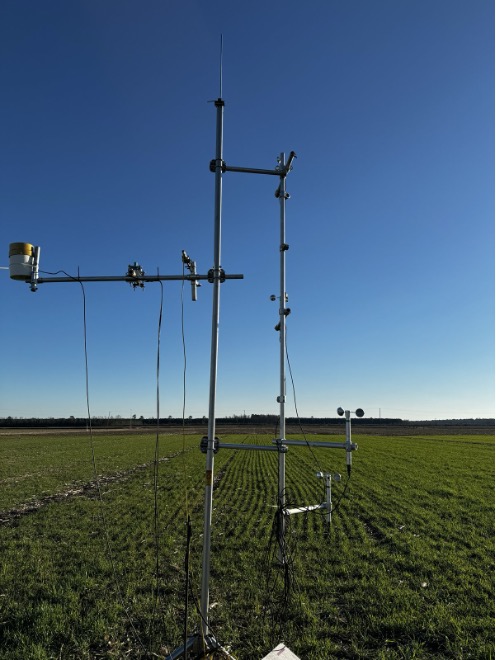
North Carolina Tidewater, USA
A new AgNUE supersite representing southeastern U.S. row crop systems in the Piedmont region.

Status:
New complete supersite

Lead institution:
North Carolina State University

Soil type:
Ultisol

Supersite lead:
Alex Woodley
Why the supersite?
The Tidewater is a flat, low-lying region along the coastal sounds of eastern North Carolina, where the land sits barely above sea level and is farmed with the help of drainage. It is warm, humid and wet, and its soils are among the most productive in the state, growing maize, soybean, wheat and cotton. Here the supersite will help AgNUE study nitrogen mitigation on poorly drained mineral soils with a shallow water table, where saturation drives denitrification and nitrous oxide loss. It is one of two North Carolina sites representing distinct physiographic regions, paired with the Coastal Plain supersite, and is well suited to testing precision nitrogen management, cover crops, enhanced-efficiency fertilisers and other emerging mitigation approaches.
What this site helps AgNUE compare
Paired with the well-drained Coastal Plain supersite, this site lets AgNUE test the same crops and nitrogen management across two contrasting drainage regimes, one dominated by leaching and one by denitrification. That comparison shows how long growing seasons, double-cropping, high-biomass cover crops and advanced nitrogen management influence nitrogen use and losses across the region.
Warm, humid subtropical climate
Represents intensive crop production in northern France, including major crops such as wheat, maize, barley, oilseed rape, sugar beet and pea.The site has a warm, humid subtropical climate, with a mean annual temperature around 16 °C, high annual rainfall and a long frost-free season. It is the only humid subtropical climate in the AgNUE network. These warm, wet conditions drive strong nitrogen losses and rapid residue and cover-crop turnover, making the region an important setting for testing mitigation under a climate the rest of the network does not cover.Represents intensive crop production in northern France, including major crops such as wheat, maize, barley, oilseed rape, sugar beet and pea.
Long-season double-cropping
The long growing season makes double-cropping possible, including winter wheat followed by soybean.
High-biomass cover crops
Warm winters support high cover-crop biomass and substantial nitrogen inputs from legumes.
Precision and enhanced-efficiency nitrogen
Supports precision nitrogen application, enhanced-efficiency fertilisers, improved placement and emerging mitigation approaches.
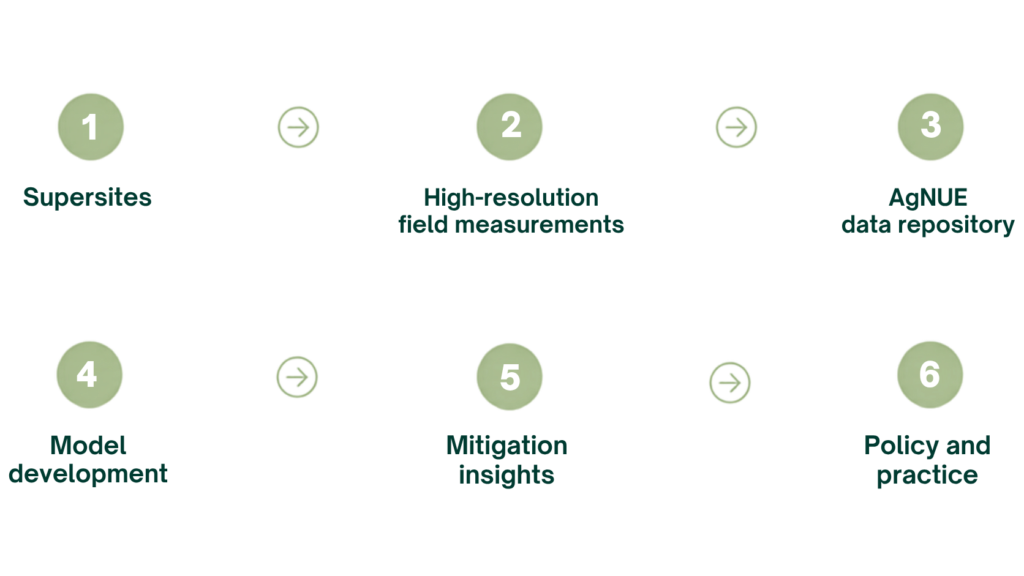
From supersites to impact
A shared pathway across the AgNUE platform.
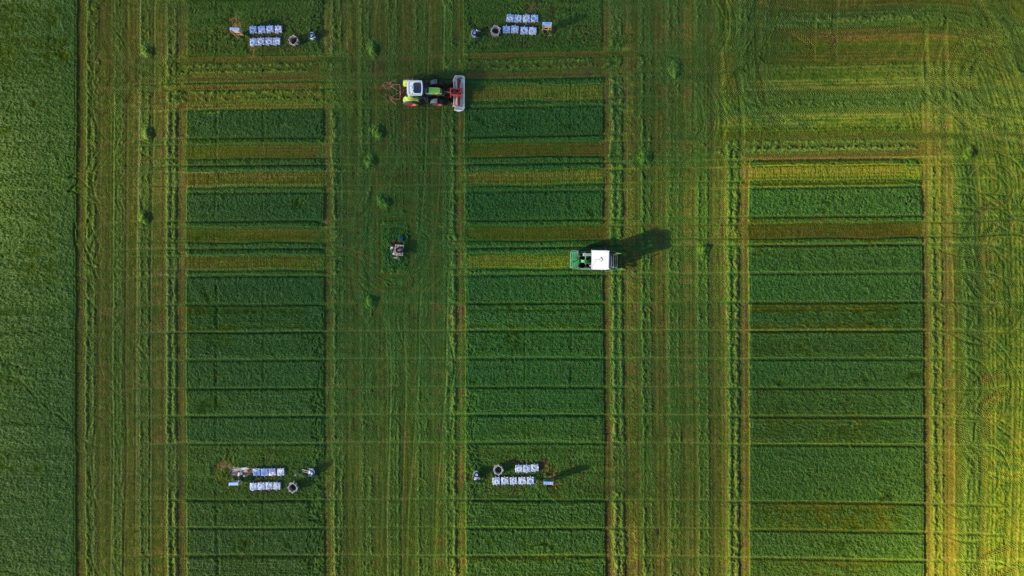
Explore images from the supersite
Dive into a selection of images revealing the agricultural landscapes and research activities at our Sinderhoeve supersite.
Discover our other supersites
There are 12 supersites connected to the AgNUE platform. Explore them here.