AgNUE partners met in Aarhus on October 8-9 for a technical workshop and field visit to learn from the experience already gained through SmartField. The collaboration provides an important foundation as AgNUE develops a wider network of supersites across Europe and the United States.
AgNUE is building something ambitious: a network of field sites capable of generating high quality and comparable data on nitrogen use efficiency and losses across very different agricultural systems.
But the project is not starting from scratch.
A central part of AgNUE is to build on the technical and scientific experience developed through SmartField, a Danish research initiative that combines advanced field measurements, modelling and data infrastructure to improve the understanding of agricultural nitrogen losses. The AgNUE project specifically builds on this experience as it establishes a wider, coordinated supersite network across Europe and the US.
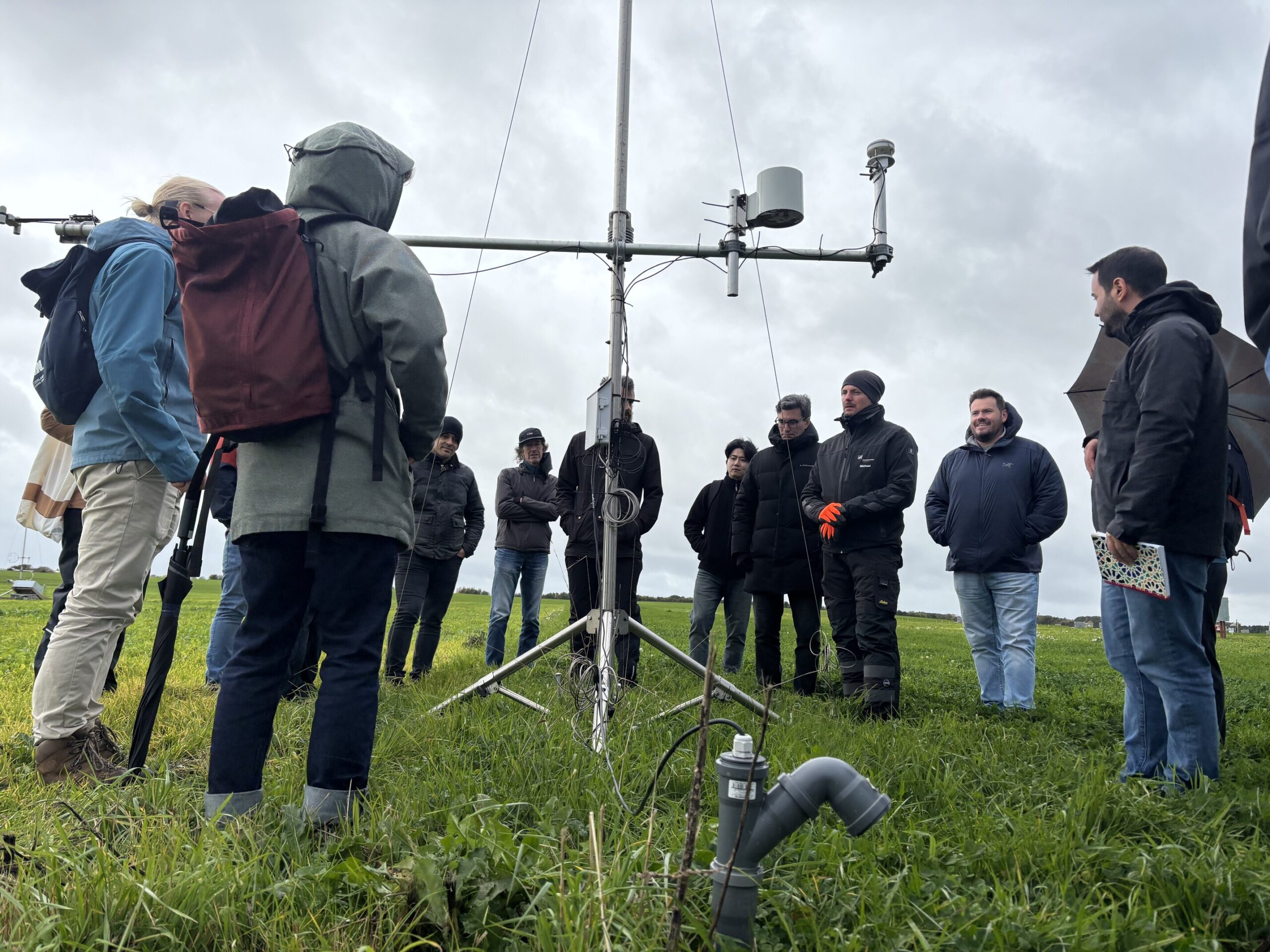
That connection was put into practice during an AgNUE technical workshop in Aarhus on 8–9 October. Partners came together to discuss equipment, measurement protocols, soil characterisation, data collection and the practical operation of supersites, with SmartField researchers sharing experiences from the two existing Danish sites. The programme also included a field visit to the SmartField supersite in Selling, where participants could see the measurement infrastructure in operation.
Different conditions, common measurements
One of the lessons from SmartField is that even sites located relatively close to each other cannot simply be treated in the same way.
“Even though Denmark is a small country, there are relatively big differences in environment and soil,” Michael Erlang-Nielsen from the Danish Technological Institute and SmartField pointed out during the workshop.
The two SmartField sites therefore provide experience with establishing and operating advanced measurement systems under different Danish agricultural conditions. Local soil properties, cropping systems and environmental conditions all influence how a site can be designed, which equipment can be used and how measurements are carried out.
For AgNUE, the same question now has to be addressed on a much larger geographical scale.
The two existing SmartField supersites will be complemented by 10 new sites across Europe and the US, covering a wide range of crops, management systems and agro-ecological conditions.
The objective is not to make every site identical. Rather, AgNUE is developing a common framework that enables regional differences while maintaining the level of standardisation needed for meaningful comparison. This includes common approaches to site selection, instrumentation, measurement protocols, data processing and quality assurance.
From field measurements to comparable data
This balance between local adaptation and international comparability is fundamental to AgNUE.
Measurements from the supersites will ultimately feed into a common data and modelling framework. Analytical equipment, field measurements and data processing will therefore be aligned across sites, while site-specific factors such as soil texture and water conditions are incorporated into the individual designs.
SmartField also provides experience beyond the physical setup of the sites. The Danish Technological Institute, which holds the SmartField grant, is an AgNUE partner and will draw on its SmartField experience in both field measurements and the development of AgNUE’s data infrastructure.
The workshop therefore represented more than a visit to an existing research site. It was an opportunity to transfer practical knowledge from an established system into the next phase of AgNUE, and to discuss how those experiences can be adapted to very different agricultural conditions across two continents.
As the new supersites begin to take shape, that exchange of experience will be central to creating a network in which different fields can ultimately contribute to comparable, high-quality data.